
Frequently Asked Questions

-
When I returned to South Florida, I moved into a neighborhood visited often by a Great Blue Heron, a companion I frequently encountered on my walks. More than any other creature, the heron seemed to bring a touch of magic to every place I found it, whether in a botanical garden, along a lakeside path, or simply outside my window. The feeling I get when I’m lucky enough to see a heron is the same feeling I hope my quilts carry: the sense of familiar, cherished company, of nesting within Florida’s landscape, of being immersed in quiet magic and love.
-
I am open to creating a custom quilt that combines your vision and my particular style and skillset. I truly am energized by commissioned projects, especially to commemorate a moment in time.
If you’d like to commission a quilt, please reach out via the Contact page and I’ll respond as soon as I can, usually within a day.
We’ll begin with a conversation about what you’re envisioning, your timeline, and whether I am able to take on your project.
Please note that I do not work from existing sewing patterns. My process is more free‑form in that the design often evolves as I sew. I’ll take your initial ideas and translate them into a design that reflects both your vision and my artistic approach. If you have a sentimental fabric you would like to include, you are absolutely welcome to send it to me and I am happy to include it.
Each quilt requires at least six weeks to complete. Hand-quilted pieces generally require additional time because of the slower, more tactile process.
-
I have never formally timed the full process, but I typically require at least 6 weeks of lead time for a commissioned project. If I am just creating something on my own, the process can span anywhere from a day for something truly simple to a year or more- it just depends on my flow of inspiration and energy and whatever else in life is happening.
In general, the actual act of quilting on my sewing machine (once all of the layers are created and basted) takes about 5–6 hours per quilt.
Creating the binding adds another 3 hours, and hand‑stitching that binding to the quilt takes roughly 4 hours more.
This is just the act of quilting and binding the finished piece. None of this includes the time spent piecing the top or back; every individual piece must be cut, ironed, sewn, and ironed again.
Quilts require many hours of careful, repetitive work, and the entire process is truly a labor of love. -
All quilts are pieced and/or quilted with one sewing machine, my Janome Memory Craft 6700P. I do not have or use a long-arm machine, and do not send quilts to be long-armed. Sometimes I hand-sew or hand-tie for quilting, and other times I use my Janome to quilt with simple lines and occasional use of decorative stitches. I love my Janome, its size, the all-metal body, and its resiliency throughout daily sewing.
I unexpectedly purchased this machine at the South Florida Quilt Expo and am so glad I did. If you are interested in sewing, I highly recommend purchasing a machine at a quilt show - you get to test it out and will likely get a great deal! -
Each quilt contains a diverse array of fabrics sourced from multiple origins. Sometimes quilts are primarily comprised of repurposed clothing, while other times scraps are sourced from fellow quilters and textile suppliers. I occasionally source small amounts of yardage from sources like Material Goods, Merchant & Mills, Etsy sellers, and A Verb for Keeping Warm. My favorite hand-dyed fabrics are from Kye & Hardy.
-
I source vintage cutter quilts and occasionally transform them into pouches, jackets, or sachets. When a quilt has only minor wear—such as frayed binding—I may simply replace the binding and make small repairs so it can continue to be enjoyed in its original form.
My decision‑making process for working with vintage quilts is guided by a deep respect for their history:
Does the quilt have a known provenance? If so, I will not cut it.
Does it clearly belong to a specific community or cultural quilting tradition (for example, Amish quilts)? If so, I will not cut it.
Is it in excellent condition and likely to be appreciated as originally intended? If so, I will not cut it.
In most cases, I purchase already‑cut sections of cutter quilts rather than intact quilts. These pieces often show less wear than the rest of the quilt and are ideal for giving new life to fragments that might otherwise be lost.
It is a genuine honor to work with vintage quilts, each one carrying its own story, and to help them continue bringing beauty and comfort for years to come.
-
No, I am not on social media. I was previously, and ultimately decided that social media was fundamentally not in alignment with my enjoyment of quilting or of life.
-
Yes, all quilts are made in a smoke-free home.
-
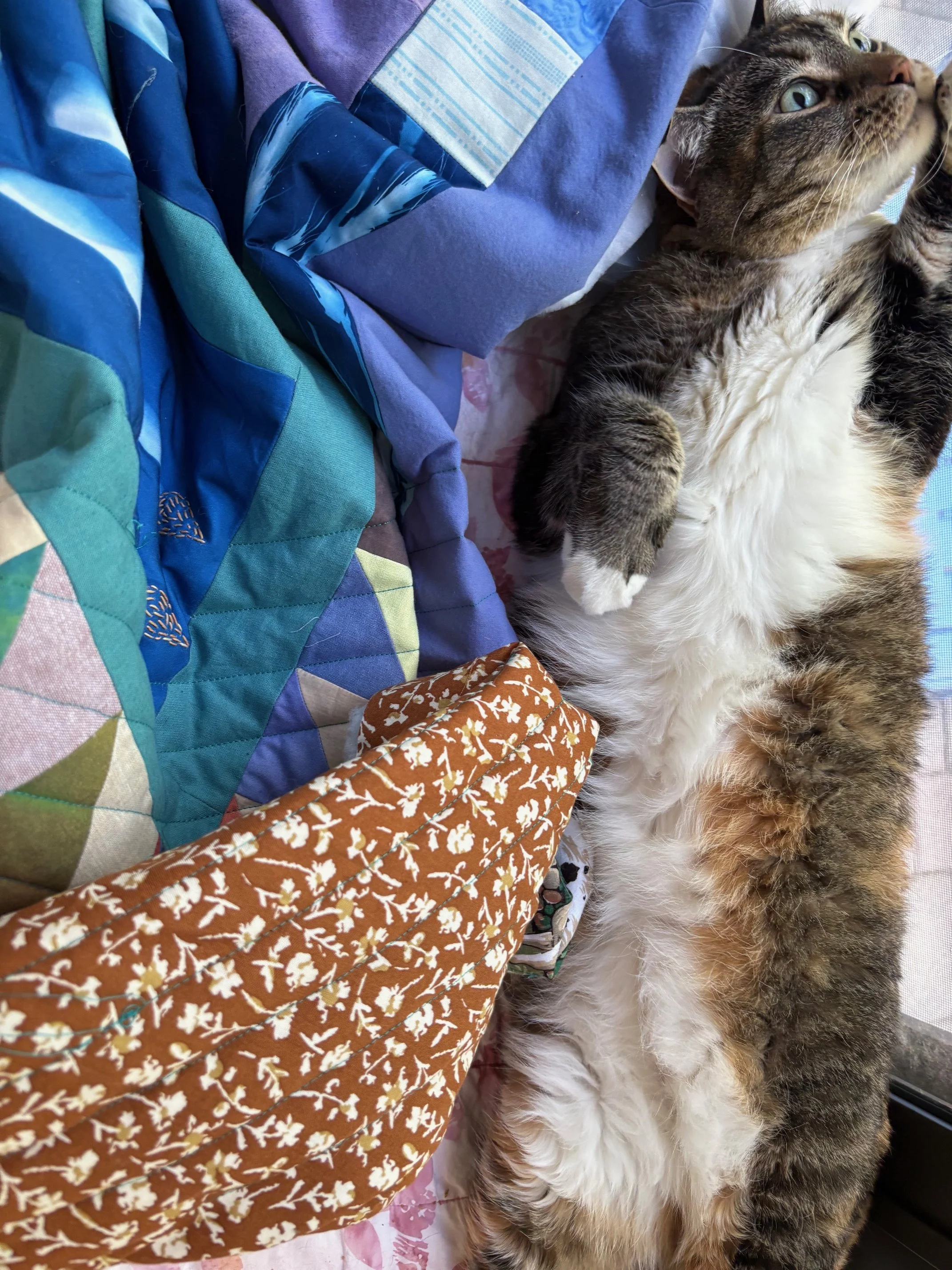
I am a proud cat mama to two fur babies. If you have a cat allergy, you should not purchase a quilt from Blue Heron Quilts.
-
I wash quilts on the delicate cycle with Color Catcher sheets and dry on low.
Quilts made with certain hand-dyed fabrics, such as those from Cherrywood, may require special care to prevent colors from bleeding. When applicable, specific washing instructions—including the use of products such as Synthrapol—will be provided with the quilt. -
All sales are final, and I cannot guarantee that I will be able to successfully mend the issue with your quilt. However, I welcome you sending it to me so that I can attempt to mend it for a fee, though the mending work may be visible. If binding begins to wear, I could replace the binding for a fee. My goal is for you to have this quilt for generations.
-
All sales are final.
-
The following resources inspire me:
1. South Florida Modern Quilt Guild. I served on the Board from 2023 - 2025 and am so grateful to learn from these wonderful quilters. This guild offers exceptional programming, monthly meetings, and a robust membership of folks who do not hesitate to offer their skills and wisdom to support new learners. You do not have to live in South Florida to join - we have remote members all over the country.
2. Quiltfolk. Their publications and programs are unparalleled. Whether you are interested in learning basic sewing skills or about cultural quilting traditions around the world, their content is well-curated, accessible, and always interesting.
3. The Creative Act: A Way of Being by Rick Rubin. This book is not about quilting specifically, but about being a creative person and channeling your inner creative flow state to create art. If I can recommend any single book, it is this one.
4. Seamside Podcast by Zak Foster. I'm really not much of a podcast listener but I find this one to get at the heart of how quilts connect us. It always inspires me to listen to this podcast, whether it's an episode of "Free Advice" or a deeper dive into a quilter's journey.